Saturday, February 28, 2015

Versace Embraces Greece and the Hashtag


It was high tech and high drama at Versace as the Greek key, which has long been one of the company’s signatures, appeared on a giant metallic structure at the back of the runway and as a pattern on sweaters, bags, shoes – and the Internet.

The key motif – make that #greek for a hashtag – was embedded in the quilted suede bags that Donatella Versace was showing off backstage. The symbol was also worked into the Perspex heels of boots that climbed up and away in patent leather and suede until they reached thigh high, under brief dresses.


There are people who might consider it discomforting to build a collection around a reference to a country that is currently in the news more for its debt problems than its ancient history, but this Greek key has long been a Versace symbol. And why would Donatella let a pan-European financial crisis change her fashion plans? 


Instead of slashing debt, her eyes were on slashing dresses, which were split up the side and set at an angle as if in a geometry lesson. In vivid primary shades of scarlet, grass green, and sunshine yellow, leather popped out on the runway, while the few quieter pieces included a compass-drawn cape or a rounded fur.


Since Donatella took her bow in a super-skinny pants suit, narrow trousers were also part of the collection. 
The game of keys was mildly challenged by a play on words: ‘Versace’ broken into a mix of letters, which is something I remember from Gianni’s ‘Circus’ collection from so many moons ago


Donatella did not have much new to say, but the collection was presented con brio. She herself seemed unsure as to what the Greek key hashtag would do or whether it was actually an emoji that could be added on to texts and messages to express yourself. I am tempted to say that it was all Greek to her. 


Donatella was adamant about the advantage to Versace of the new digital adventure, however. “I know in my mind and my heart that with the archive – I do not want to look at it any more,” she said. “Thank God for the archive. But now it is time to forget, let go, and think of the future.” 


suzy menkes - vogue paris

Milan Fashion Week: Gucci's smart revamp ensures brain over brawn

Alessandro Michele, the brand’s new creative director, begins work by discarding traditional glitz with a pared back, philosophically influenced women's wear show


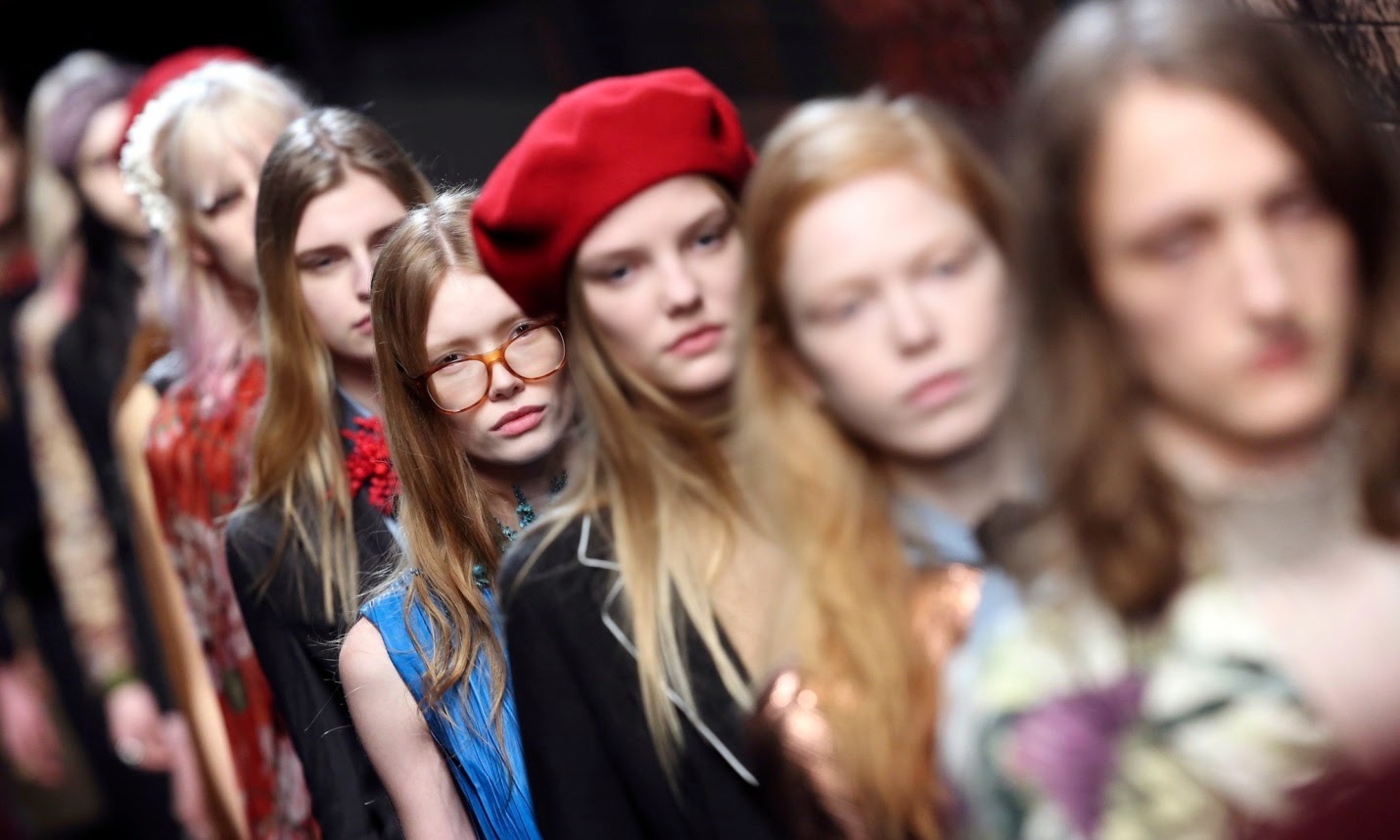
Models parade at the end of the Gucci’s first womenswear show under Alessandro Michele at Milan fashion week on Wednesday. Photograph: Alessandro Bianchi/Reuters
They say that the geeks are taking over the world. But did anyone ever imagine that intellectuals would commandeer that most glitzy of fashion houses, Gucci?
That was the story at Milan fashion week on Wednesday, as the luxury brand’s new creative director, Alessandro Michele, presented his first womenswear collection. Traditionally, Gucci shows are full of clear references to the jet-setter’s lifestyle – bling-encrusted red carpet gowns or nautical blazers perfect for super yachts. On Wednesday, even before the models took to the catwalk, it was clear that this would be different.
Gone were the plush pale carpets, glittering chandeliers and trays of champagne that traditionally greet Gucci’s guests. Instead, the venue was pared back. The walls, floors and ceilings were painted black. Show notes referenced philosophers Giorgio Agamben and Roland Barthes (“the contemporary is the untimely”). In lieu of the usual amphitheatre seating – where guests used to gossip and celebrity spot while facing each other across the catwalk – seats were arranged to face the edges of the room, providing an altogether more introspective experience.
Rather than the usual supermodels in sweeping gowns, the models were slight and long-haired, both male and female, cast and styled so their gender was obscured. Clothes were not brazenly sexy – this was librarian chic, with most looks styled with glasses.
There were midi skirts, tank tops, brightly coloured fur coats and huge furry shoes akin to those produced by rival brand Céline. Flowers are a major part of Gucci’s heritage – the brand’s Flora design was famously created for Grace Kelly in the 1960s – and they were in evidence here, though in subversive ways. Men wore stems in their hair; floral fabric was used to beautiful effect on pleated transparent dresses and boxy suits for both genders. Fur-cuffed military coats brought to mind the outerwear in Wes Anderson’s The Grand Budapest Hotel while pussybow blouses recalled the edgy designs of JW Anderson.

Salma Hayek arrives at the Gucci show on Wednesday. Photograph: Jacopo Raule/Getty Images
There were jaunty artist’s berets (Salma Hayek, whose husband Francois-Henri Pinault is CEO of Gucci parent company Kering, wore a turquoise one in the front row) and tight bobble hats that recalled another famous Wes Anderson costume: Bill Murray’s beanie in The Life Aquatic with Steve Zissou. The only hint of the Gucci logo itself was seen, occasionally and subtly, on belt buckles and on the two bags that appeared in the show. It was a restrained move for a house so associated with leather goods.
Michele’s debut came after a tough few months for Gucci. In December, it announced that chief executive Patrizio di Marco and creative director Frida Giannini, one of fashion’s most famous power couples, were to leave after 11 years. Their departure was linked with falling sales, with Gucci’s lacklustre results comparing unfavourably to those of the revitalised Kering stablemate Saint Laurent.
Gucci, the analysts said, was failing the increasingly sophisticated luxury consumer, who is tired of obvious bling and hungry for something more unique. In this respect, Gucci was losing out to under-the-radar brands like Bottega Veneta and Céline.
Who could solve this problem? Rumours swirled about the identity of Giannini’s replacement, with most assuming a name to match the star power of Nicolas Ghesquière at Louis Vuitton. In January, however, it emerged that Giannini had left the company early – five days before the presentation of the brand’s menswear collection – and head accessories designer Michele was to take over.
Despite his relative anonymity, Michele’s dramatically different aesthetic, also in evidence in January’s rushed-together menswear show, won headlines. Still, difficulties within the company were underlined even on the morning of Wednesday’s show, when a letter from former CEO Di Marco found its way to the New York Times. In it, he suggested he had been forced out of the company, saying: “against my will, I leave my cathedral uncompleted.”
Backstage, Michele said he knew the Gucci archive “so well – better than my own flat” but that he had to design in his own way. He seemed almost eerily relaxed, looking like the archetypal hippie with long hair and a full beard, wearing a shell necklace and stacks of silver rings. “This is my language,” he said. “I can’t speak another language.”
And he was smiling as cheers came from the crowd and from the models. In the crush backstage, champagne was finally poured.

the guardian

Prada’s Milan fashion week show goes for heightened femininity

Models wear fondant fancy colours and princessy accessories, as Miuccia Prada confounds expectations once more


Models wear creations for Prada women’s autumnl-winter 2015 collection at Milan fashion week. Photograph: Antonio Calanni/AP
Miuccia Prada has built a multimillion-euro business on confounding expectations. Her autumn/winter 2015 Prada on Thursday was no exception.
If anything, Prada’s many fans suspected this collection would be sombre and unisex. That was the flavour of the brand’s menswear presentation in January, which featured an even split of male and female models and was described as “the first part of the autumn/winter 2015 fashion show”. This, then, was to be the second part. 

In fact, it was an excessively feminine show. Models were all female and wore suits in fondant fancy colours styled with long, princessy leather gloves. Dresses were empire line and decorated with bows.
Models’ high ponytails recalled Grace Kelly’s regal up dos; a repeated flower motif appeared as a hair clip and as brooches. From dress coats to low “v” backless tops to strappy dresses, the silhouette felt like a futuristic take on the 1960s, thanks in part to the use of a fabric that Mrs Prada afterwards described as a “type of jersey”, which gave the clothes a flat Jetsons texture.
A repeated pattern, which Prada explained was a magnified digital print of a molecule, added to this futuristic sense. So, too, did the set, which had the corrugated steel and antechambers of a spaceship. 
There were plenty of typically Prada twists. As well as two-tone Mary Jane sandals that look certain to set tills ringing, many of the shoes were outright ugly – tight rubbery knee-high boots with thick, contrasting soles that squeaked as models walked – and the colour combinations (a chartreuse dress over a lime green shirt with Barbie pink cuffs appeared paired with a bottle green jumper) often went beyond beautiful to downright weird.

Backstage, Prada wore a low key uniform-like outfit – a black kilt and matching blazer with epaulettes over a crisp white shirt – with last season’s skyscraper-inspired gold wedge heels.
With typical ambiguity she said that the collection had three titles: “soft pop”, “variation on beauty” and a sense of being “about thinking” rather than “about a fantasy”.
It was full of references to “real and fake,” and was also about “impossible beauty and the cliche of what women like.” Yes, there were princesses on the catwalk, she said, “but I hope there was irony there”.
Prada’s shows are famous for setting the agenda in fashion, so trend-watchers will keenly note this vision of heightened femininity. Hemline geeks will be aware, too, that her skirt-lengths were just above the knee – a fresh approach in a sea of mini and midi skirts – while trousers were awkward kick flares cut above models’ ankles. 
One thing’s for certain – from the bags the models carried, in a variety of shapes, to sunglasses, costume jewellery and layers of knitwear over shirts – there was plenty to buy at a variety of price points.
This comes just a week after Prada announced a 1% fall in sales in 2014, following stellar growth of 9% and 29% in 2013 and 2012. Thursday’s bright, attention-grabbing, commercial but unexpected and brainy collection is the kind of solution a complex brand like Prada is looking for.

the guardian

The Powerpuff Girls Redefined What Little Girls Are Made Of..

The hit Cartoon Network show, which is set for a reboot in 

2016, appealed to kids and adults with its three subtly 

subversive, (super)empowered female leads.


The creation myth of The Powerpuff Girls is derived from a nearly 200-year-old English nursery rhyme called “What Little Boys Are Made Of” ("Snips, snails, and puppy-dogs’ tails," if you were wondering). The old-timey reference to "sugar, spice, and everything nice" mentioned in the opening credits may feel fitting nearly 10 years after Cartoon Network cancelled the wildly popular show. After all, The Powerpuff Girls relied on a slew of tropes that may come off as a touch regressive, if mostly harmless, namely an occasionally cloying cutesiness, and stereotypically feminine visual elements like hearts, flowers, and stars.

But the show, which Cartoon Network confirmed will be rebooted in 2016, made it clear that its three female superhero leads weren't "the perfect little girls" of lore, because when creating them in a lab, father/boss Professor Utonium added an extra ingredient: Chemical X. This laboratory mishap didn't render the girls shapeless blobs (like their villains The Amoeba Boys); rather, the blunder gave them superpowers. In other words, they werebetter than perfect little girls.

Elementary school-aged kids like myself watching the show in the late-1990s didn't see it as subversive. We didn't know it would pass the Bechdel Test or that the creator, Craig McCracken, had originally wanted to name Buttercup "Bud." We didn't know that the show regularly maintained the top ratings among Cartoon Network's original series for both kids and adults. And yet, here was a kids' show that managed to appeal to both boys and girls without scrubbing the word "Girls" from its title. Even in recent years, the titles of female-led animated films like Tangled and Frozen offer no hint of who their protagonists are.
The Powerpuff Girls meanwhile had three young female superheroes as leads—something that hasn't quite been replicated in popular animated TV shows for the younger demographic since. In the world of live-action superhero films, women have yet to achieve anything close to parity, and one need look no further than the new Wonder Woman film to see how "sexy" and "strong" remain at odds with one another when it comes to how audiences think girls with powers need to look. But the Powerpuff Girls, with their giant heads and tiny, under-drawn bodies, almost dare anyone to say they don't "look like" superheroes. And while adult female superheroes are without exception sexualized, Blossom, Bubbles, and Buttercup aren't because, well, they're little girls. Which is perhaps what makes trio's much-touted femininity so divergent: Their sexuality never has to define them. Even Buttercups' sometimes-aggressive brand of tomboyishness is normalized within the show; her personality never fully gets in the way of her taking down the bad guy with her more conventionally "girly" sisters.

In announcing the show's reboot, Cartoon Networksaid its current roster of (mostly boy-led) original shows helped cement its position "as the #1 network with boys 6-11, while also seeing double-digit increases among girls 6-11 through 2014." It's fitting and timely now that the network is revivingThe Powerpuff Girls, with Nick Jennings ofAdventure Time executive-producing. The smart and exceptionally funny Adventure Time features two male leads (well, one human boy and one boy-dog), but it also features an array of unique female characters: the angsty but tough Vampire Marceline, the Valley Girl-esque Lumpy Space Princess, and the ruler of the Candy Kingdom, Princess Bubblegum. These characters aren't without their traditional gendered qualities, but they're part of a world that's more nuanced and self-aware than that Townsville was.

While The Powerpuff Girls is preparing to be reborn in a new decade, for a certain generation of its original young fans, its legacy has already somewhat been sealed. Spinoffs, merchandising, and future feature films aside, the series proved that there was no single formula to make the ideal girl, and that sometimes the best move was to mix in something weird, undefinable, and mysterious along with the sweeter elements.

How the Internet Made Modest Fashion Cool

For plugged-in, religious Millennial, stylishness and faith 


have never been more compatible

Mimu Maxi


Historically, modest clothing has often been at odds with what's considered "cool," especially in the classic American sense. This week, the Supreme Court heard oral arguments in the case of a young Muslim woman who was denied a job at an Abercrombie and Fitch store because her headscarf didn't fit in with the company's desired "look." As my colleague Emma Green noted, "'classic' Americans probably dress like Protestants—which is to say, they don't dress in much religious garb at all."
And yet as Abercrombie's profits continue to tumble, modest fashion's profile is rising, thanks in part to an increasingly outspoken number of trend-conscious religious Millennials who stand by the idea that covering up can be glamorous, sexy, and, yes, cool. Corresponding with the rise of Instagram and fashion blogs, these Christians, Jews, Muslims, and Hindus—mostly young women based in the U.S.—took to the Internet to vent their frustrations about limited fashion choices and to share creative tips for elevating their wardrobes. The result: growth and visibility for the modest-fashion movement and a new generation of religious-lifestyle bloggers, designers, and trendsetters from across the faith spectrum.
It’s a surprisingly enticing focus group for the fashion business. Millennials are much less likely to be “religious” than their parents, with 25 percent of the generation identifying as unaffiliated with a faith—nearly double the rate for Baby Boomers. But as the Pew Research Center’s study on "Religion Among Millennials" points out:
Millennials remain fairly traditional in their religious beliefs and practices … Though young adults pray less often than their elders do today, the number of young adults who say they pray every day rivals the portion of young people who said the same in prior decades. And though belief in God is lower among young adults than among older adults, Millennials say they believe in God with absolute certainty at rates similar to those seen among Gen Xers a decade ago.
Dressing conservatively according to a religious code can prove challenging. At the level of pure convenience, appropriate pieces need to be cherry-picked from across several stores. On a broader scale, professional dress codes are often unfriendly to, or at least limiting of, religious attire: Last year, for instance, the Pentagon made new concessions for members of the American military to wearturbans, head scarfs, and yarmulkes if they asked permission; advocacy groupsfired back, noting the "presumptive bar" remained.
And for young people, there’s the ever-important issue of wanting to fit in and look trendy while maintaining their sense of uniqueness. Take fashion blogger Chandra Leonardo: An Apostolic Christian from northern California, Leonardo details her conservative outfits on her website MoMoMod (short for "More Modern Modesty"). Growing up, she says, she always felt out of place among her peers. She wore maxi skirts years before they regained mainstream popularity as the carefree weekend staples of boho-chic celebrities.
Among the best-known names associated with the modest-fashion movement is perhaps Summer Albarcha, otherwise known on Instagram as Hipster Hijabis. The 19-year-old Muslim started Instagramming her outfits in August 2012 and quickly built up a fan base (she now has more than 47,000 Instagram followers) that includes young Muslims, people of other faiths, and nonbelievers alike. “I really think [religious dressing] doesn’t have to look backwards or uniform,” said Albarcha, whose outfits range from leather pants paired with Chelsea boots and a plaid scarf, to maxi skirts and slouchy chartreuse sweaters.
One of Albarcha’s collaborators, Brooklyn-based shop Mimu Maxi, is another well-known, modest-fashion staple run by Orthodox Jewish sisters-in-law Mimi Hecht and Mushky Notik. The pair started their brand in the summer of 2013 with the Hasidic female community in mind, but Mimu Maxi soon gained a broader, loyal following. (This interfaith approach has hit rough patches at times: Last summer, the sisters saw a huge backlash for posting a photo on Instagram of Albarcha wearing a hijab.)
Of course, modest fashion isn’t universal in its rules or its politics. Muslim women adhering to the dress code are encouraged to cover their ankles and have sleeves up to their wrist, with only feet and face visible to the public. Hasidic women are required to cover the collar bone, elbows, and knees. While all the customs vary just a little—“Everyone has a different conception of what modesty is to them,” Albarcha noted—fabric choice, colors, and cuts offer a surprising number of unlimited options. In fact, bloggers across the religious spectrum continuously emphasize the freedom within being held to a dress code, often describing the challenge as “liberating” and “fun.”
That combination of freedom and restraint means there are huge avenues for business with modest fashion, particularly on a global scale. With a fast-growing Muslim youth demographic tuned into the latest fashions around the globe, a vast group of people is underserved by traditional fashion chains: There are nearly 800 million Muslims younger than 25, according to Shelina Janmohamed, vice president of Ogilvy Noor, an Islamic marketing agency.
“Not only do you have more Muslims to target, but they are increasing in numbers faster and they are young. And, contrary to a lot of expectations, they are interested in brands and they are interested in asserting some kind of individuality through what they purchase,” Janmohamed told Business of Fashion last year.
But the inclusiveness of the modest-fashion movement also means its appeal stretches beyond the faithful. Atheists are among the most vocally supportive on social media of modest blogs and Instagrams—a point everyone I spoke to made to me without prompting. “If you notice from our Instagram page, it’s not a small hobby,” Hecht said of Mimu Maxi’s social-media presence. “We’re not about being a fashion brand. It’s more about feeling good and being true to yourself, telling women to be authentic, genuine.”

Beyond Hipster Hijabi's name, there's the fact that Mimu Maxu is based in Brooklyn's Crown Heights—a neighborhood known as a rising hipster mecca as well as a home to a large Orthodox population. Consider the frequency with which “hipster” is appended to various religious identities (sometimes by members themselves): Mipsterz (Muslim hipsters),
 Jewish hipsters, and Mormon Hipsters. The label "hipster," at the very least, is more inclusive and malleable than Abercrombie's preppy, "classic East Coast collegiate style of clothing."This emphasis on authenticity in part explains another interesting variable in the modest-fashion trend: Part of its appeal to Millennials has hinged on its association with the nebulously defined “hipster” label. “[Hipsterism] is about being unique but not being too unique,” sociologist Kevin Lewis told me. “It’s marginal differentiation, where you want to be different enough from your peers but not so different that you want to be ostracized.”


Modest-fashion trendsetters like Mimu Maxi's Hecht and Notik don't shy away from the oft-scorned term the way their secular counterparts might. Before Refinery29 referred to the pair as "Hasidic Hipsters" in a video last year, the pair said they had never even considered the label. But, perhaps by dint of the cool factor or the broader sales appeal, they don't mind.
"People who shop with us who aren’t Jewish don’t really care about religion," Hecht said. "They just like the fabric and the cut. There’s Muslims who like us, atheist hipsters who like us. We’re not hiding who we are, and it’s cool.”

the atlantic. (tanya basu)

Honouring the finest hairstylists in Qatar.


Madi International, one of the leading distributors of internationally reputed professional beauty brands across the entire Middle East, introduced Goldwell; top German hair care brand to Qatar in June last year. 

Apart from being a world-renowned brand of hair products, Goldwell is also the first hair care brand in the region that celebrates hairdressers with great pride. Setting high standards of education for today’s hairdressers can drive the hair fashion market to grow along with international trends. It plays a pivotal role in elevating the standards of the beauty industry. “When it comes to beauty, Madi International is a brand that is always pushing the envelope to explore new boundaries and set new benchmarks. We believe in not only growing in the industry, but growing with it” said Maher Makarem, General Manager, Madi International Qatar. “We are happy to spot the light on Goldwell in this endeavour to ensure that all aspiring hairstylists are into the profession they deserve to be.” 

Madi International in coordination with Tajmeel, the Qatar International Beauty Academy, recently honoured a batch of their finest stylists celebrating them after completing Goldwell’s training. This ceremony was conducted at Old Marriott. As the driving force behind the training and the ceremony, Madi aims at enhancing the skill and knowledge of these hairdressers to the highest standards. The company’s ambition is to train and inform the hairdressers of the top salons in Qatar and minimize high risks. When it comes to promoting beauty and style, Madi has been at the forefront of such initiatives. And this collaboration with Tajmeel allowed them to do just that. 

Qatar International Beauty Academy (QIBA), Tajmeel was founded by the Social Development Centre (SDC), Tajmeel is an institution that is known to provide training of the highest calibre within the beauty industry. “It is our sense of responsibility in support of Qatar 2030 vision that we extend our professional team and widen our courses every year to increase opportunities in the community; providing the industry with skilled professionals and individuals with creative talent and personal growth”, said Beverley Crowther – Tajmeel Prinicpal, Designation, Tajmeel. The training is designed to train hairdressers of the top salons in Qatar. They are also trained on how to handle Goldwell’s products, such as their hair coloring solutions, and learn to apply their treatments under the guidance of the professionals.

Goldwell has made its mark across the globe with its superior and innovative products for all hair types and hair needs. By bringing Goldwell to the region Madi International made Goldwell established itself as a respectable brand and gained the respect of high-end salon professional profiles across the GCC. 

Ciaté names Olivia Palermo as Guest Creative Director for 2015


Olivia Palermo

Ciaté, the London beauty brand that revolutionised nail art, has announced the appointment of Olivia Palermo as its Guest Creative Director for 2015. The collaboration will see the style icon creating four limited edition collections for the brand, all of which are set to be stocked at Sephora stores globally. 

A New York socialite and model best known for her role in the US reality TV show ‘The City’, Olivia will be utilising her wealth of fashion and design experience to inject an iconic elegance into the debut collaboration, including bespoke packaging, product and formula. 

“I’m so thrilled to be working with Ciaté London as Creative Director for 2015, bringing to life my ideas for colour cosmetics for the first time. I’m an admirer of their innovation, I’ve enjoyed the creative process and I’m looking forward to the launch of the products coming to life,” Olivia said.

Dubbed ‘Olivia Palermo X Ciaté London Colour Collection’, first to be launched in May will be Ciaté’s inaugural seasonal edit, which will be a limited edition collection for summer. It consists of three shades of nail enamel, all carefully hand-picked by Olivia as the most wearable yet fashion forward colours that suit all skin tones. Each will feature enhanced formulations consisting of a mesh lock technology prolonging colour-wear whilst strengthening nails and providing a glossy finish. 
The Fall 2015 collection will even be more exciting as it will see Ciaté expanding its beauty line with the introduction of colour cosmetics through the partnership. Olivia, inspired by years of experience using the best beauty brands and formulas on the market, will launch make up products with richly pigmented formulas, suede inspired textures, high-tech ingredients and divine packaging with a modern vintage feel, making every product look and feel like a luxury fashion accessory. This range is set to include a hydrating and smoothing moisture-rich lipstick; a luxurious smoky eye palette for pigmented, weightless blendability; and, a contouring compact, which will enable to you to achieve Olivia’s signature runway-ready cheekbones.